

学会动态
学会期刊《Journal of Machine Learning》2026年第三期上线发行,欢迎查阅
发布时间:2026/09/22 14:23
分享:
2026年9月,中国工业与应用数学学会期刊《Journal of Machine Learning》(JML)上线发行2026年第三期。
JML期刊由鄂维南院士与鲁剑锋教授联合主编,致力于为全球机器学习学者搭建起高水平、可持续的学术交流平台,汇聚了来自全球机器学习及交叉领域的权威学者。
JML期刊是机器学习领域一本全新的期刊,现由中国工业与应用数学学会(CSIAM)、北京大学国际机器学习研究中心、北京科学智能研究院联合主办,香港Global Science Press出版,并已成功被美国数学学会的在线数学评论和书目数据库MathSciNet收录。
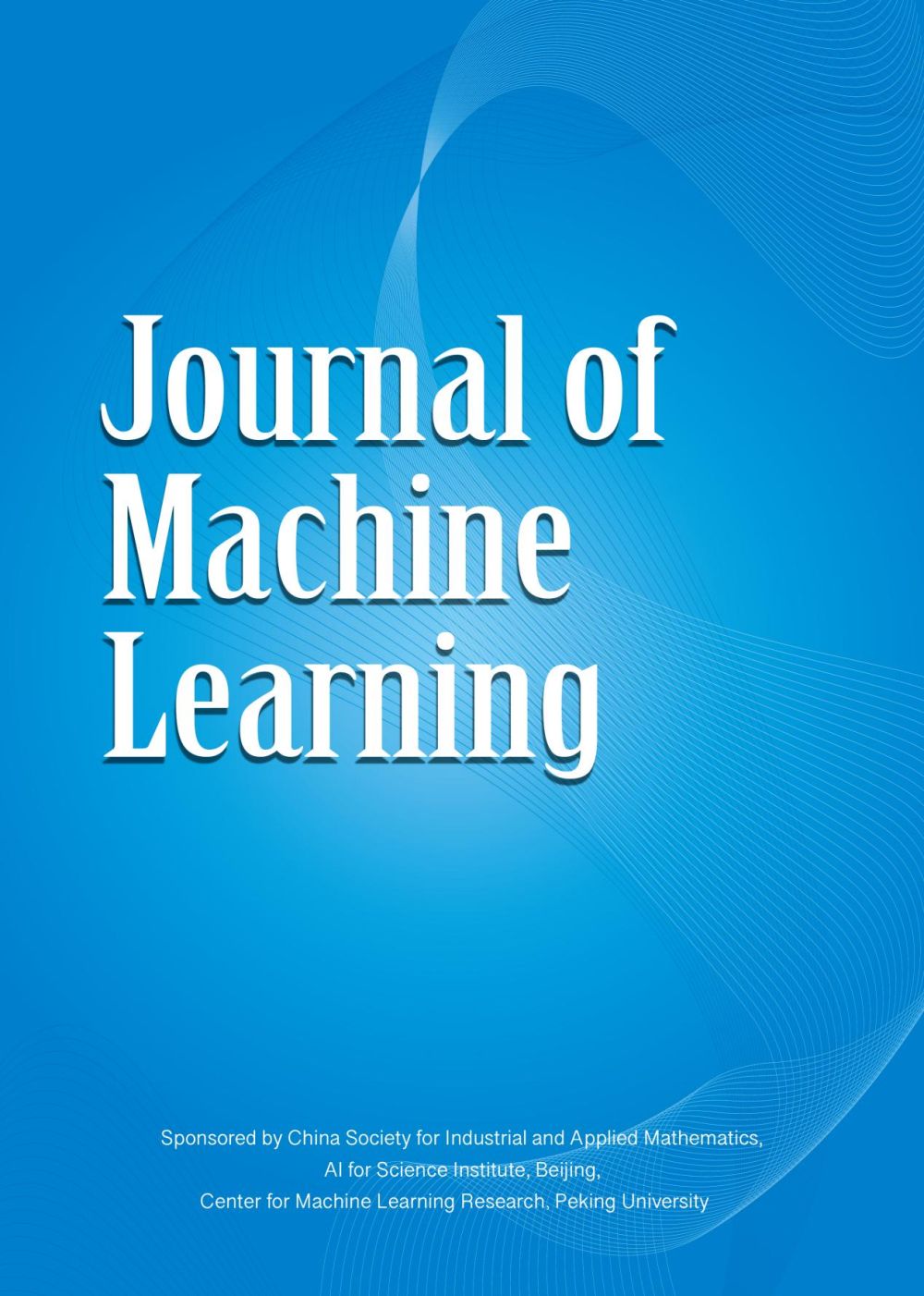
期刊2026年第三期共5篇文章,所有发表文章均实行开放获取,论文目录、摘要及作者信息如下:
Leonie Kreis, Evelyn Herberg, Frederik Köhne, Anton Schiela, Roland Herzog
SensLI: Sensitivity-Based Layer Insertion for Neural Networks
Abstract: The training of neural networks requires tedious and often manual tuning of the network architecture. We propose a systematic approach to inserting new layers during the training process. Our method eliminates the need to choose a fixed network size before training, is numerically inexpensive to execute and applicable to various architectures including fully connected feedforward networks, ResNets and CNNs. Our technique borrows ideas from constrained optimization and is based on first-order sensitivity information of the loss function with respect to the virtual parameters that additional layers, if inserted, would offer. In numerical experiments, our proposed sensitivity-based layer insertion technique (SensLI) exhibits improved performance on training loss and test error, compared to training on a fixed architecture, and reduced computational effort in comparison to training the extended architecture from the beginning. Our code is available on https://github.com/mathemml/SensLI.
Shuyan Ge, Rujun Jiang, Luo Luo
Accelerating First-Order Methods for Bilevel Optimization under General Smoothness
Abstract:Bilevel optimization is pivotal in machine learning applications such as hyperparameter tuning and adversarial training. While existing methods for nonconvex-strongly-convex bilevel optimization can find an -stationary point under Lipschitz continuity assumptions, two critical gaps persist: improving algorithmic complexity and generalizing smoothness conditions. This paper addresses these challenges by introducing an accelerated framework under Hölder continuity-a broader class of smoothness that subsumes Lipschitz continuity. We propose a restarted accelerated gradient method that leverages inexact hypergradient estimators and establishes theoretical oracle complexity for finding -stationary points. Empirically, experiments on data hypercleaning and hyperparameter optimization demonstrate superior convergence rates compared to state-of-the-art baselines.
Arnulf Jentzen, Adrian Riekert, Philippe von Wurstemberger
Abstract: In this article, we propose a new deep learning approach to approximate operators related to parametric partial differential equations (PDEs). In particular, we introduce a new strategy to design specific artificial neural network (ANN) architectures in conjunction with specific ANN initialization schemes which are tailor-made for the particular approximation problem under consideration. In the proposed approach, we combine efficient classical numerical approximation techniques with deep operator learning methodologies. Specifically, we introduce customized adaptions of existing ANN architectures together with specialized initializations for these ANN architectures so that at initialization we have that the ANNs closely mimic a chosen efficient classical numerical algorithm for the considered approximation problem. The obtained ANN architectures and their initialization schemes are thus strongly inspired by numerical algorithms as well as by popular deep learning methodologies from the literature and in that sense we refer to the introduced ANNs in conjunction with their tailor-made initialization schemes as algorithmically designed artificial neural networks (ADANNs). We numerically test the proposed ADANN methodology in the case of several parametric PDEs. In the tested numerical examples the ADANN methodology significantly outperforms existing classical approximation algorithms as well as existing deep operator learning methodologies from the literature.
Kun Zhao, Haoke Zhang, Jiayi Wang, Yifei Lou
Transformed Regularizations for Robust Principal Component Analysis: Toward a Fine-Grained Understanding
Abstract:Robust principal component analysis (RPCA) aims to recover a low-rank structure from noisy, partially observed data that is also corrupted by sparse, potentially large-magnitude outliers. Traditional RPCA models rely on convex relaxations, such as nuclear norm and norm, to approximate the rank of a matrix and the functional (the number of non-zero elements) of another. In this work, we advocate a nonconvex regularization method, referred to as transformed (TL1), to improve both approximations. The rationale is that by varying the internal parameter of TL1, its behavior asymptotically approaches either or . Since the rank is equal to the number of non-zero singular values and the nuclear norm is defined as their sum, applying TL1 to the singular values can approximate either the rank or the nuclear norm, depending on its internal parameter. We conduct a fine-grained theoretical analysis of statistical convergence rates, measured in the Frobenius norm, for both the low-rank and sparse components under general sampling schemes. These rates are comparable to those of the classical RPCA model based on the nuclear norm and norm. Moreover, we establish constant-order upper bounds on the estimated rank of the low-rank component and the cardinality of the sparse component in the regime where TL1 behaves like , assuming that the respective matrices are exactly low-rank and exactly sparse. Extensive numerical experiments on synthetic data and real-world applications demonstrate that the proposed approach achieves higher accuracy than the classic convex model, especially under non-uniform sampling schemes.
Weiheng Zeng, Ruoxi Lu, Kun Wang, Tiegang Liu
SCINN: Solution Character-Informed Neural Network for Scalar Conservation Laws
Abstract:The physics-informed neural network (PINN) faces significant challenges when approximating solutions to conservation laws, particularly in ensuring conservation and accurately resolving discontinuities. To address these limitations, we propose solution character-informed neural network (SCINN), a novel framework that incorporates the boundedness constraint, implicit solution form, and Rankine–Hugoniot condition into the loss function, thereby enforcing conservation properties. Furthermore, we integrate a physics-based adaptive refinement (PAR) strategy to dynamically prioritize training near discontinuities, substantially improving the network’s ability to capture sharp gradients. Numerical experiments are conducted on benchmark problems, including the inviscid Burgers equation, the Lighthill-Whitham-Richards (LWR) traffic flow model and the Buckley-Leverett problem. The results show that compared to existing PINN-based methods, SCINN delivers outstanding performance in solving scalar conservation laws with wave interactions and non-convex non-concave flux functions. Compared to conventional PINN, SCINN yields a maximum reduction of 98.7% in mean squared error (MSE).
《Journal of Machine Learning》欢迎大家积极投稿,投稿网站:https://ef.msp.org/submit_new.php?j=jmlearn
期刊主页网站:https://www.global-sci.com/jml
学会出版委员会供稿
中国工业与应用数学学会办公室
地址:北京市海淀区清华大学数学科学系B202室
电话:010-62787525 建模竞赛咨询电话:010-62781785
学会总部办公基地(长沙)
地址:湖南省长沙市龙喜路2号星沙区块链产业园三楼
电话:0731-86207515
学会邮箱:office@csiam.org.cn


 扫描二维码关注中国工业与应用数学学会微信公众号
中国工业与应用数学学会 版权所有